Symbolic placement note
Left Hand vs. Right Hand: The Crucial Difference in Rose Quartz Placement
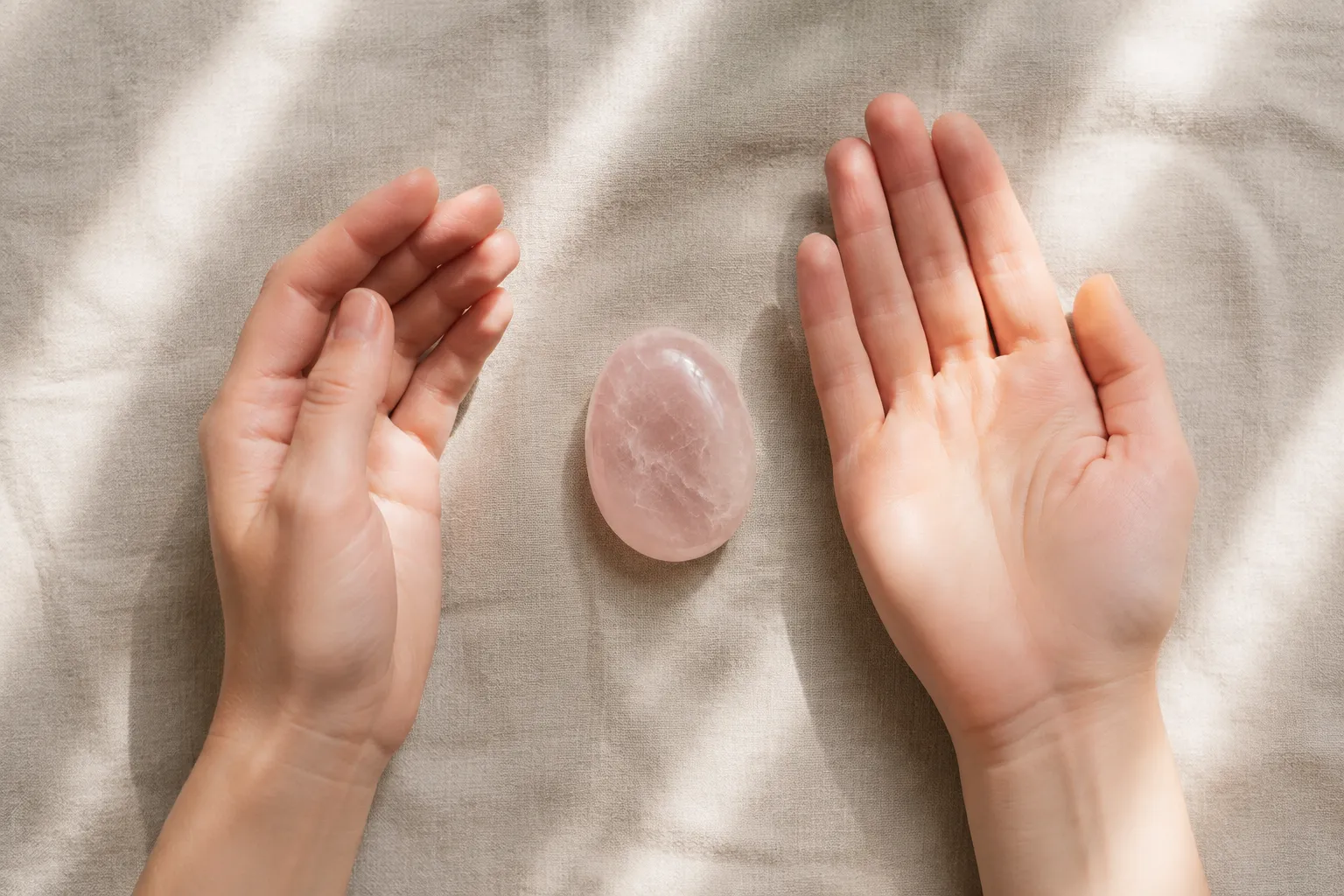
The short answer to Crystal hand placement meaning is this: in common crystal-practice language, the left hand is often treated as receptive or inward, while the right hand is often treated as projective or outward. With rose quartz, that usually means the left hand is chosen for receiving, resting, or reflection; the right hand is chosen for offering, expressing, or carrying an intention outward.
That distinction is symbolic. It is not something the stone’s appearance can confirm, and it is not a mineral fact.
upward
Start with the broader guide
Use the broader guide first if you need the full scope before this page.
The practical difference
If you are holding rose quartz and wondering where it “belongs,” the choice is less about the stone and more about the meaning you want to give the moment. In many crystal-practice explanations, the left hand is the receptive hand: a place to take in, pause, and notice. The right hand is the projective hand: a place to send out, act, or direct.
That language is interpretive. It is common in ritual use, but it is not proved by geology, and rose quartz itself does not carry a visible label that tells you which hand is correct. Treat the distinction as a way to frame intention, not as a mechanism that guarantees an outcome.
For rose quartz specifically, the tone is usually gentle. The stone is commonly associated with softness, emotional reflection, and a warm decorative presence, so the left hand often fits when the practice is meant to feel inward-facing. The right hand often fits when the same stone is used as a sign for outward intention.
Left hand
When the left hand makes more sense
Choose the left hand when the practice is about receiving rather than sending. That usually fits quiet moments, journaling, meditation, reflection, or simply holding the stone while you settle down. In symbolic terms, the left hand can stand for openness, taking in, or letting something be noticed before it is acted on.
With rose quartz, that receptive framing often pairs with ideas like:
- resting with the stone rather than doing something with it
- noticing feelings without trying to direct them
- using the moment as an inward pause
- treating the stone as a prompt for reflection rather than action
This is the cleaner choice when you want the ritual to feel contemplative. It is also the simpler choice if you are not trying to assign a strict directional meaning at all. Many people use the left hand because the receptive language feels natural, not because they need a fixed rule.
Right hand
When the right hand makes more sense
Choose the right hand when the practice is framed as expression, intention-setting, or outward movement. In many crystal-practice traditions, the right hand is treated as projective or outward-facing, so it can be used when you want rose quartz to mark an intention you plan to carry into speech, action, or a decision.
That framing often fits use cases like:
- setting a simple intention before leaving home
- holding the stone while speaking or writing a wish
- using the stone as a reminder to act with steadiness or warmth
- moving from reflection into a next step
The right hand can feel more active because the symbolism is more active. That does not make it more correct. It just changes the emphasis. If left-hand language is about receiving, right-hand language is about expressing.
For some readers, that makes the right hand a better fit when rose quartz is less about quiet reflection and more about a visible reminder to carry a value outward into the day. The stone stays the same; the symbolic frame changes.
What changes the choice
The strongest reason to use one hand over the other is usually not a rule from the stone. It is the context of the practice.
A few practical checks matter more than people expect:
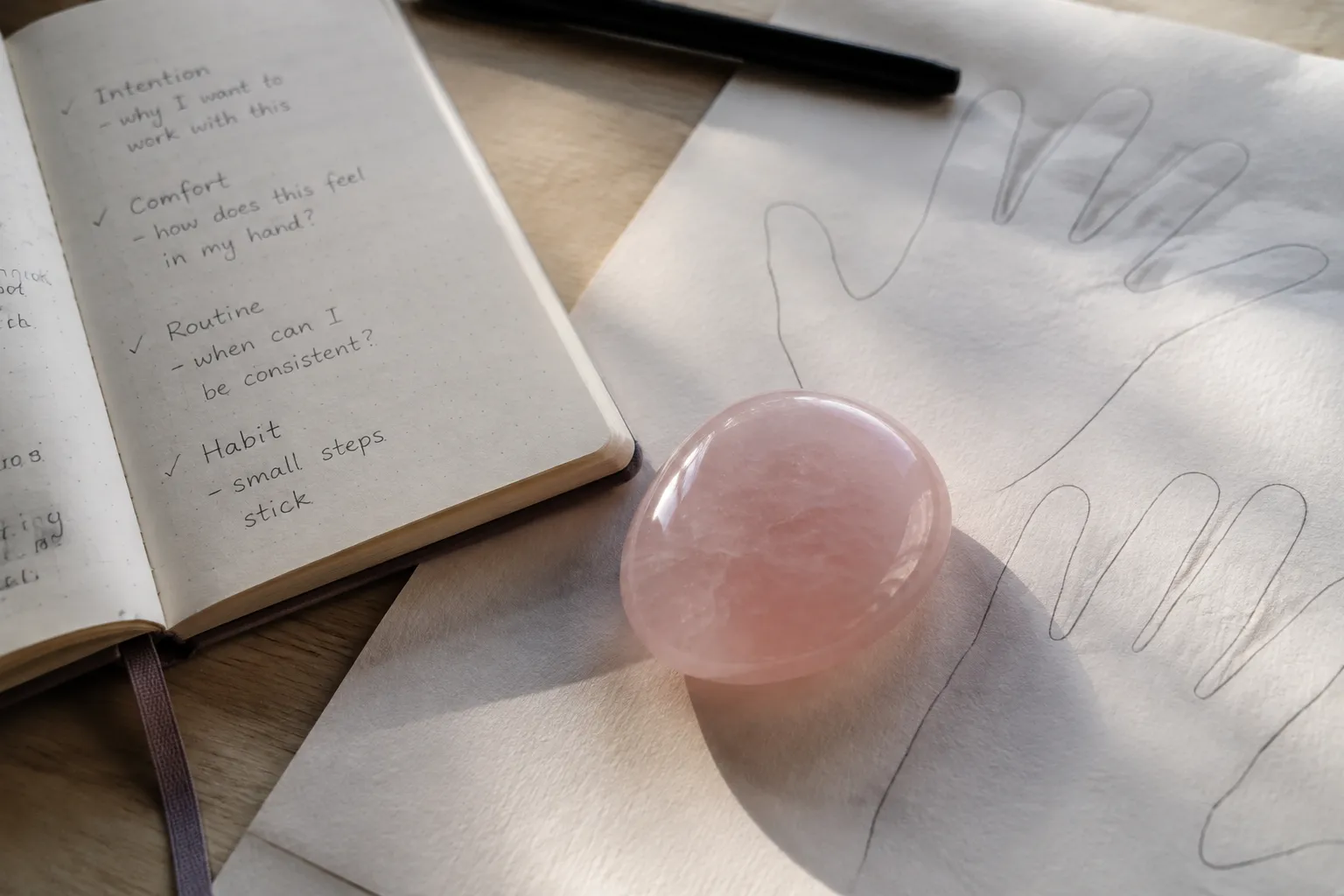
- Your intention: Are you trying to receive, reflect, and pause, or to express and act?
- Comfort: Which hand lets you hold the stone without tension?
- Routine: Are you using it during meditation, journaling, a short pause, or before a task?
- Habit: Do you naturally work from one side of the body more comfortably than the other?
If you want the practice to feel structured, let the hand match the purpose. If you want to keep it simple, choose the hand that feels natural and stop there. The symbolic system is there to support attention, not to create a new problem to solve.
This is also where the boundary matters. There is no visible clue in rose quartz that can confirm energy flow, ritual meaning, or a guaranteed effect from switching hands. Mineral references can support that rose quartz is a real mineral object. They cannot turn a hand-placement tradition into physical proof. If the wording starts sounding like a health claim, it is better kept in the realm of personal reflection, tradition, or symbolic use.
What the stone cannot tell you
Rose quartz cannot tell you whether left or right is better. It cannot verify a tradition by color, shape, polish, or temperature. It also cannot prove that one hand changes an outcome in a measurable way.
That matters because the same object can be used in several different ways:
- as a mineral specimen
- as a decorative object
- as a ritual token
- as a prompt for reflection
Only the last two depend on symbolic interpretation. And even there, the interpretation is flexible. Some practitioners use left for inward work and right for outward work. Others ignore the distinction and focus on comfort, mood, or intention. Both approaches fit the same basic fact: the hand choice is a framework, not a test.
So if you came here wanting a hard rule, the honest answer is that no hard rule exists in the material itself. The common distinction is left = receptive and right = projective, but it is better treated as symbolic language than as proof.
A grounded way to decide
If you want a simple, usable answer, use this one:
- Choose the left hand when you want rose quartz to support receiving, reflection, softness, or a quiet inward pause.
- Choose the right hand when you want rose quartz to support expression, outward intention, or carrying a feeling into action.
- Choose either hand when the symbolic difference matters less than the habit itself.
That is the practical center of rose quartz hand placement. The left-right distinction can be helpful, but it is not compulsory, and it is not validated by appearance alone. It works best when you keep it modest: a ritual frame, not a claim about mineral power.
Quick FAQ
Does rose quartz have a built-in left or right meaning?
No. The left-versus-right reading comes from symbolic crystal-practice language, not from the stone’s visible traits.
Can I ignore the hand rule altogether?
Yes. If the hand choice adds friction, use the hand that feels natural and keep the practice simple.
What is the safest way to think about it?
Treat left and right as a personal framing tool: inward for receptive use, outward for projective use. That keeps the practice useful without making it sound like proof.
If you want the cleanest reading of the tradition, remember the simplest version. Left is often read as inward. Right is often read as outward. Everything else depends on the practice, not the stone.